
Fence Installation Techniques for Difficult Terrain – Complete Guide 2026
While standard cattle fence installation on flat pasture follows predictable patterns, difficult terrain introduces complex engineering challenges that demand specialized techniques. This comprehensive guide provides professional solutions for installing durable, reliable fencing across the most challenging landscapes.
Engineering Principle: Terrain-specific installation methods can extend fence lifespan by 200-300% compared to standard techniques in challenging conditions.
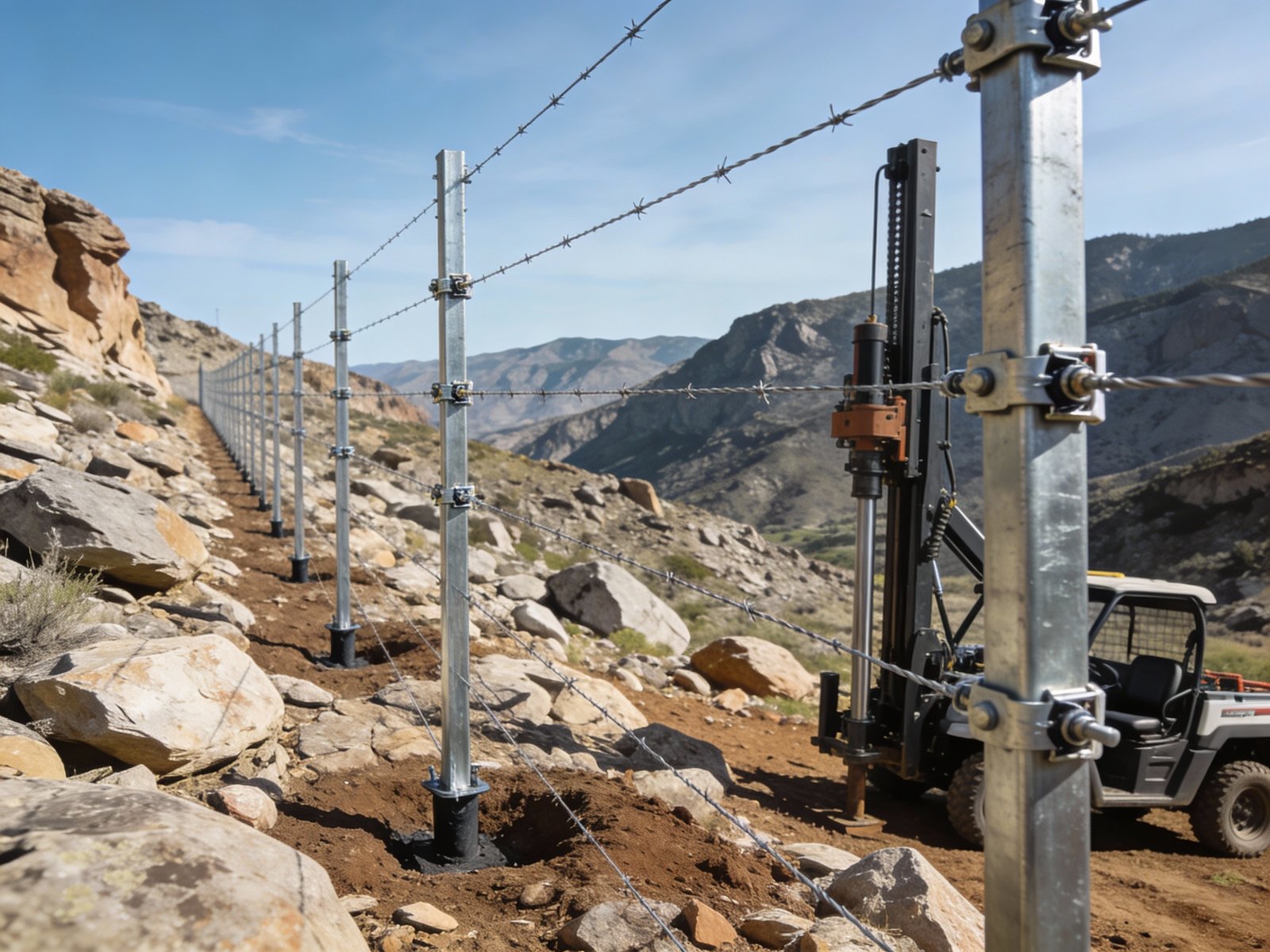
Rocky & Hard Soil Terrain
Geological Challenges & Engineering Solutions
Primary Regions: Mountainous areas, arid zones, glacial till deposits
Structural Stress Points
- Post splitting from rock pressure
- Wire tension concentration
- Corner brace failure
- Ground penetration limitations
Installation Complications
- Auger bit damage and wear
- Post alignment inaccuracy
- Reduced holding strength
- Increased equipment costs
Professional Drilling Techniques
| Method | Equipment Required | Depth Capacity | Rock Size Limit | Cost/ft |
|---|---|---|---|---|
| Rotary Hammer Drilling | Hydraulic hammer, carbide bits | 3-4 feet | Up to 12″ diameter | $8-$15 |
| Rock Auger System | Skid-steer mounted, tungsten teeth | 4-6 feet | Up to 24″ diameter | $12-$25 |
| Diamond Core Drilling | Specialized rig, water cooling | 6-8 feet | Solid bedrock | $25-$50 |
| Explosive Assisted | Licensed blasting, safety gear | As needed | Any size | $15-$40 |
Post Selection Strategy
- Steel T-posts: 1.33-1.66 lb/ft, driven installation
- Helical anchors: Screw-in design, minimal excavation
- Composite posts: UV resistant, no splitting
- Reinforced wood: Pressure treated with steel cores
Cost Premium: 30-60%
Installation Protocol
- Pre-drill pilot holes: 75% of post diameter
- Use gravel backfill for drainage
- Install post collars for lateral support
- Reduce spacing to 8-10 feet with proper wire spacing and tension design
Time Increase: 40-80%
Critical Safety Note: Always conduct subsurface scanning before drilling in rocky terrain. Hidden voids or boulders can cause equipment damage and operator injury.
Sloped & Hilly Terrain
Topographic Engineering Solutions
Slope Classification: Gentle (0-15°), Moderate (15-30°), Steep (30°+)
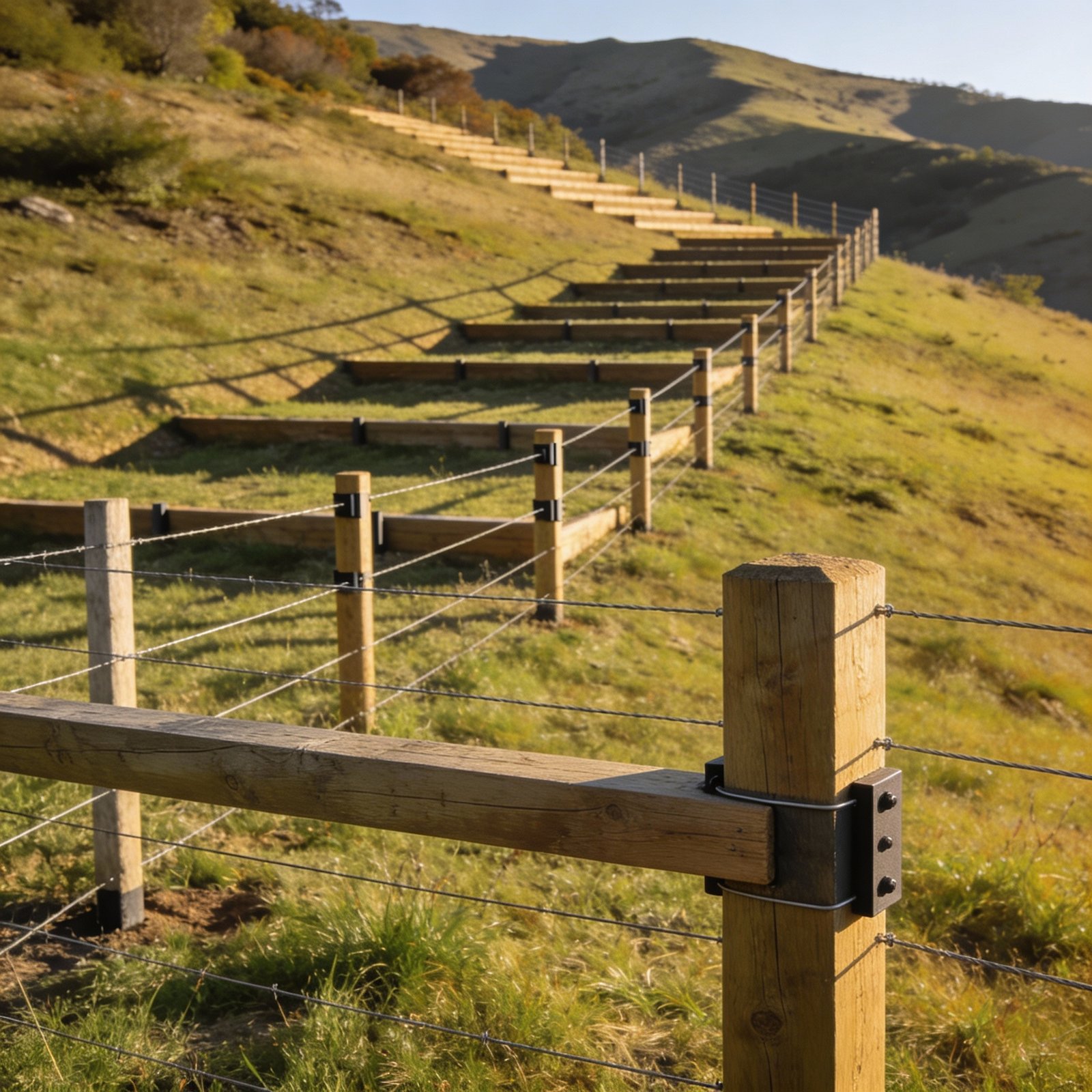
Watch this professional tutorial demonstrating slope fencing techniques and best practices:
Step Fencing Method
Best for: Slopes exceeding 25°, irregular topography
- Horizontal fence sections at elevation intervals
- Vertical risers between sections
- Consistent ground clearance maintained
- Reduced wire tension variation
Technical Specifications:
- Max slope: 45°
- Step height: 2-4 feet
- Post spacing: 6-8 feet
- Installation time: +50-75%
Contour Fencing Method
Best for: Gentle to moderate slopes, uniform terrain
- Fence follows natural ground contour
- Continuous wire tension maintained
- Minimal visual disruption
- Reduced material requirements
Technical Specifications:
- Max slope: 30°
- Post spacing: 8-12 feet
- Wire tension: 800-1200 lbs
- Installation time: +25-40%
Slope-Specific Engineering Guidelines
| Slope Angle | Recommended Method | Post Spacing | Corner Bracing | Drainage Required |
|---|---|---|---|---|
| 0-15° (Gentle) | Contour or Standard | 12-16 feet | Standard H-brace | Minimal |
| 15-25° (Moderate) | Contour with closer spacing | 8-12 feet | Reinforced H-brace | Moderate |
| 25-35° (Steep) | Step fencing | 6-10 feet | Double H-brace | Extensive |
| 35°+ (Very Steep) | Terraced step system | 4-8 feet | Triple brace system | Critical |
Pro Tip: On slopes exceeding 20°, install drainage channels above the fence line to prevent water accumulation and soil erosion around posts.
Wet Soil & Flood-Prone Areas
Hydrological Management Systems
Water Table Considerations: Seasonal fluctuations, permanent saturation
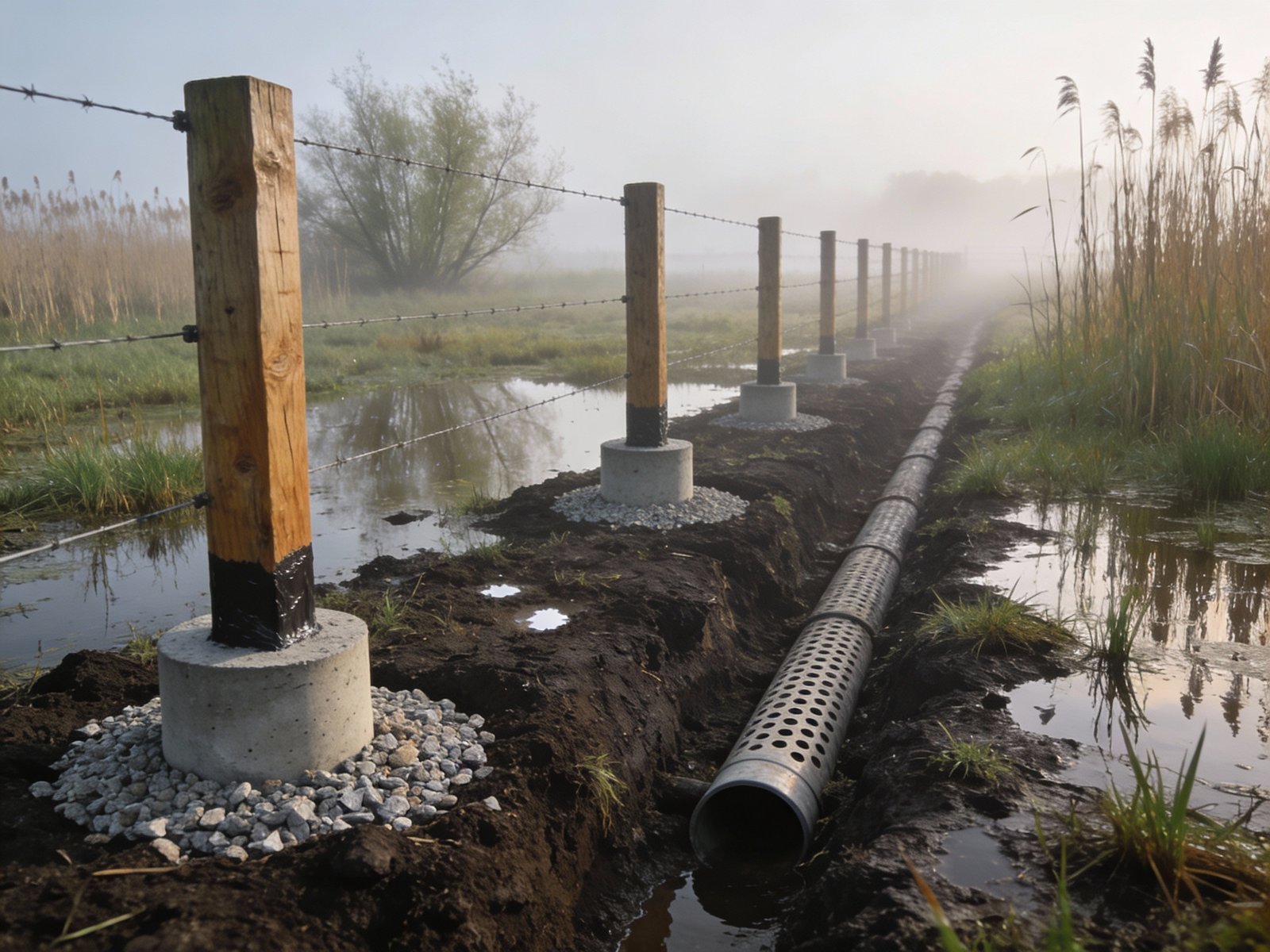
Structural Degradation
- Post rot acceleration (3-5x faster)
- Corrosion of metal components
- Soil liquefaction during saturation
- Reduced lateral support capacity
Installation Challenges
- Post hole collapse during digging
- Concrete curing complications
- Equipment mobility limitations
- Seasonal access restrictions
Advanced Drainage Solutions
Subsurface Systems:
- French drains: Perforated pipe with gravel envelope
- Geotextile wraps: Prevent soil migration into drains
- Collection basins: Temporary water storage
- Outlet channels: Direct water away from fence line
Cost: $15-$30/ft
Post Protection Systems:
- Elevated collars: 6-12″ above grade
- Waterproof membranes: Bituminous coating with galvanized coatings for corrosion resistance
- Sacrificial sleeves: Replaceable outer layer
- Ventilation channels: Air circulation around posts
Cost: $20-$45/post
Water Crossing Engineering
| Crossing Type | Recommended Solution | Span Capacity | Flood Resistance | Maintenance Interval |
|---|---|---|---|---|
| Intermittent Stream | Swing gate with concrete abutments | Up to 20 feet | Moderate (2-year flood) | Annual inspection |
| Permanent Creek | Breakaway fence sections | 20-50 feet | High (10-year flood) | Biannual inspection |
| River Channel | Elevated truss system | 50-100+ feet | Extreme (50-year flood) | Quarterly inspection |
| Seasonal Wash | Removable panel system | 10-30 feet | Variable | Seasonal adjustment |
Regulatory Note: Watercourse fencing often requires environmental permits. Consult local regulations before installing fences within 100 feet of permanent water bodies.
Desert & Sandy Soil Conditions
Aeolian Environment Adaptations
Soil Characteristics: Low cohesion, high permeability, wind transport
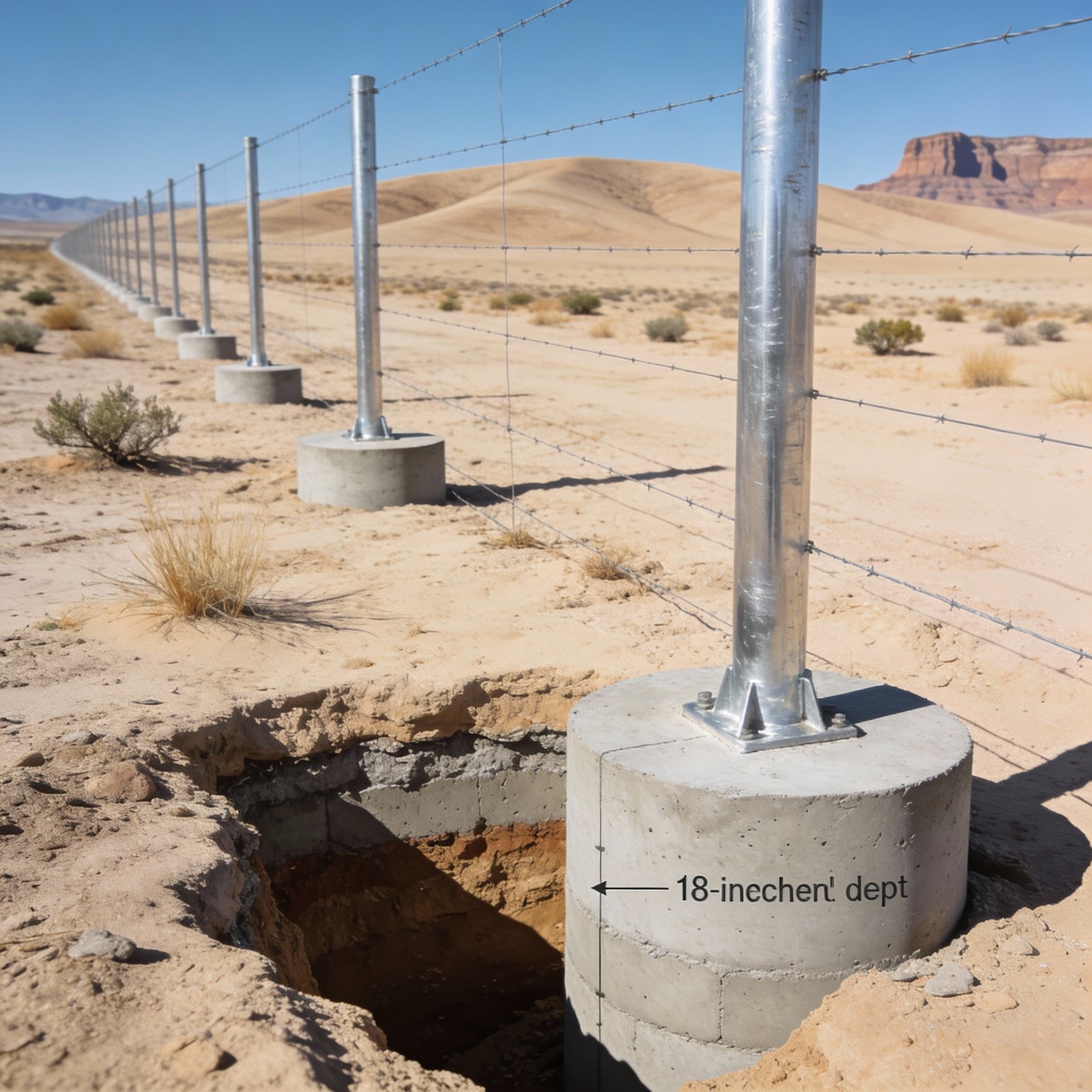
Wind Load Engineering
Deep Foundation Systems:
- Minimum burial depth: 48 inches
- Post diameter: 6-8 inches minimum
- Concrete collar: 12-18 inch diameter
- Reinforcement: Rebar cage within concrete
Wind Load Capacity:
- 60 mph winds: Standard design
- 80 mph winds: Reinforced design
- 100+ mph: Engineered system required
Specialized Anchoring:
- Helical piles: Screw-in ground anchors
- Expanding anchors: Mechanical soil engagement
- Deadman systems: Buried concrete blocks
- Tension networks: Guy wire stabilization
Soil Improvement:
- Cement stabilization: 5-10% mix ratio
- Geogrid reinforcement: Layered installation
- Compaction requirements: 95% Proctor density
Material Selection for Arid Environments
| Component | Recommended Material | UV Resistance | Thermal Expansion | Abrasion Resistance |
|---|---|---|---|---|
| Posts | Galvanized steel or composite | Excellent | Low coefficient | High |
| Wire | Aluminum-zinc coated high-tensile | Superior | Matched to posts | Medium-High |
| Fasteners | Stainless steel or hot-dip galvanized | Excellent | Minimal | High |
| Corner Hardware | Heavy gauge galvanized steel | Excellent | Engineered for range | Very High |
Desert Installation Tip: Schedule fence installation during cooler morning hours to prevent material expansion issues and improve worker safety.
Cold Climate & Freeze-Thaw Conditions
Cryogenic Soil Management
Frost Depth Considerations: Regional variations, climate change impacts
Frost Heave Mechanics
- Upward post displacement: 2-6 inches/season
- Lateral pressure from ice lenses
- Soil expansion: 9% volume increase
- Differential movement between posts
Material Stress Factors
- Brittle fracture at low temperatures
- Ice adhesion to wire surfaces
- Thermal cycling fatigue
- Snow load accumulation
Frost Line Engineering Standards
| Climate Zone | Frost Depth | Minimum Post Depth | Drainage Layer | Installation Season |
|---|---|---|---|---|
| Zone 1 (Mild) | 0-12 inches | 24 inches | 6 inches gravel | Year-round |
| Zone 2 (Moderate) | 12-24 inches | 36 inches | 12 inches gravel | Apr-Oct |
| Zone 3 (Severe) | 24-36 inches | 48 inches | 18 inches gravel | May-Sep |
| Zone 4 (Extreme) | 36-48+ inches | 60+ inches | 24 inches gravel | Jun-Aug |
Frost Heave Prevention
- Insulated collars: Foam or air gap systems
- Thermal breaks: Non-conductive materials
- Heated foundations: For critical installations
- Expansion joints: Allow seasonal movement
Cost: $50-$150/post
Cold-Weather Materials
- Low-temperature steel: Maintains ductility below -20°F
- Arctic-grade polymers: UV and cold resistant
- Non-freezing lubricants: For moving parts
- Ice-phobic coatings: Reduce ice adhesion
Cost Premium: 40-80%
Winter Installation Warning: Concrete should not be placed when temperatures are below 40°F (4°C) without proper insulation and curing protection.
Terrain-Specific Installation Summary
| Terrain Type | Critical Adjustments | Cost Impact | Time Impact | Lifespan Expectation |
|---|---|---|---|---|
| Rocky Soil | Pre-drilling, steel posts, rock augers | +30-60% | +40-80% | 15-25 years |
| Steep Slopes | Step fencing, closer spacing, drainage | +25-50% | +50-75% | 20-30 years |
| Wet Ground | Elevated bases, drainage systems, coatings | +20-45% | +30-60% | 12-20 years |
| Desert Sand | Deep foundations, wind engineering, UV materials | +35-70% | +40-70% | 10-18 years |
| Cold Climate | Below frost line, thermal protection, expansion joints | +40-75% | +50-85% | 15-25 years |
| Mixed Terrain | Combined techniques, phased installation | +50-100% | +75-125% | Variable |
Engineering Reality: Proper terrain adaptation typically increases initial costs by 30-60% but extends fence lifespan by 200-400% compared to standard installation methods, especially important for large-scale ranch and farm applications.
Professional Implementation Guidelines
Site Assessment Protocol
Pre-Installation Survey
- Soil testing: Composition and bearing capacity
- Topographic mapping: Slope analysis
- Hydrological assessment: Water table and drainage
- Climatic analysis: Frost depth and wind patterns
Risk Assessment Factors
- Seismic activity considerations
- Erosion potential evaluation
- Wildlife impact assessment
- Regulatory compliance review
Installation Phasing Strategy
| Phase | Activities | Duration | Equipment Requirements | Quality Control |
|---|---|---|---|---|
| Phase 1: Preparation | Clearing, surveying, material staging | 15-25% of total time | Survey equipment, clearing tools | Site verification, material inspection |
| Phase 2: Foundation | Post hole preparation, drainage installation | 30-40% of total time | Drilling equipment, drainage tools | Depth verification, alignment check |
| Phase 3: Structure | Post setting, bracing, wire installation | 35-45% of total time | Post drivers, tensioning equipment | Tension testing, structural inspection |
| Phase 4: Completion | Finishing touches, cleanup, documentation | 5-10% of total time | Hand tools, measuring devices | Final inspection, document review |
Best Practice: Document all terrain-specific adaptations with photographs and engineering notes. This documentation is invaluable for maintenance planning and future expansion projects.
Conclusion: Engineering Resilience in Challenging Landscapes
Difficult terrain presents unique engineering challenges that require specialized fence installation techniques. By understanding soil mechanics, hydrological patterns, climate impacts, and topographic realities, agricultural professionals can design and install woven cattle fence wire systems that withstand environmental stresses for decades.
Fundamental Principle: The most expensive fence installation is one that fails prematurely due to inadequate terrain adaptation. Proper engineering represents insurance against future replacement costs.
Key Implementation Takeaways:
- Invest in proper site assessment – Understanding terrain characteristics is the foundation of successful installation
- Select environment-compatible materials – Match material properties to specific terrain challenges, considering wire grades appropriate for your conditions
- Implement phased installation strategy – Complex terrain often requires sequential construction approaches
- Document all adaptations – Detailed records support maintenance and future expansion
- Plan for climate change impacts – Consider changing precipitation patterns, extreme temperatures, and storm frequency
Final Recommendation: For installations in extreme terrain conditions, engage a qualified agricultural engineer or professional fence contractor. Their expertise can prevent costly failures and ensure long-term performance.
Last Updated: January 28, 2026 | Next Review: January 2027
Engineering Standards: ASTM F1661, ASAE EP486, Local Building Codes
The information provided in this guide is for educational purposes only. For complex fencing projects, consult a licensed agricultural engineer or professional contractor.